
Why I'm Building Pockli Health
Oana · August 17, 2026 · 4 min read
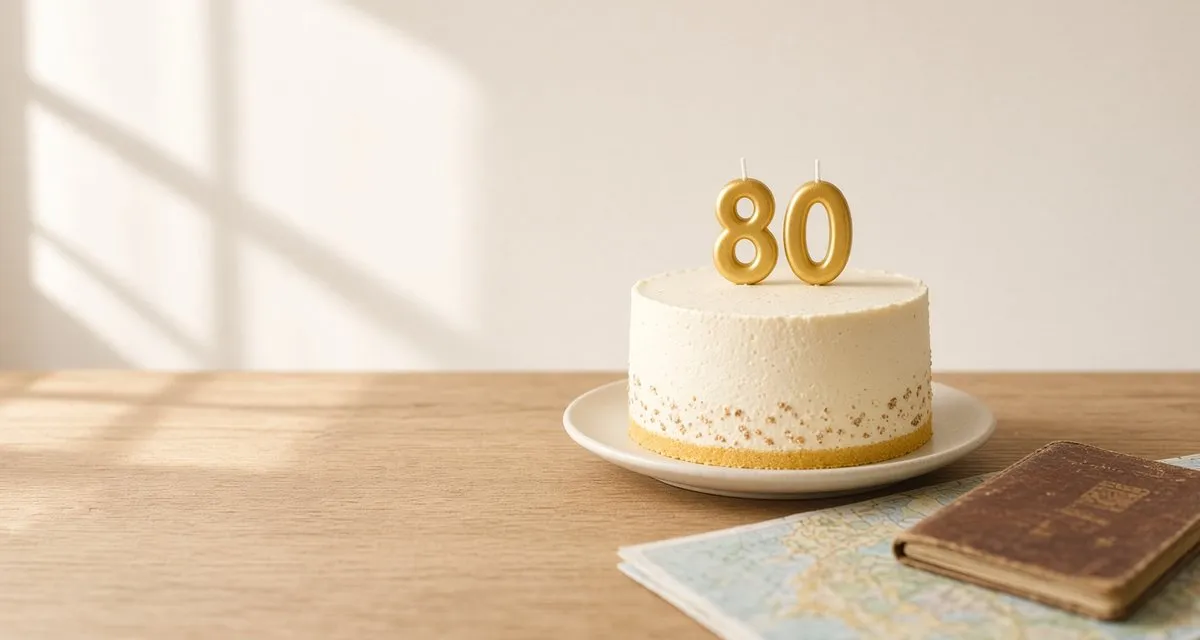
I’m in my mid-forties, and if you ask me, my health is acceptable. My lab reports would like a word.
A while back, at a workshop, I was asked a question that stuck with me: what do you want your 80th birthday to look like? My answer came quickly. I’m on my feet, fully myself, still traveling, still enjoying life — an old man by then, sure, but a fully functional one. That picture is the actual goal. And seen from that birthday, whatever my lab reports have started to say isn’t about now at all — it’s a trajectory, and my mid-forties is the point where a trajectory is still mine to bend.
I’ve been reading a lot about this lately, and the idea my reading keeps circling is that how long we live, and how well, is far less fixed than my generation grew up assuming. A surprising amount depends on the daily care we take of ourselves, and science keeps adding to what’s possible on top of that. Which reframes everything: taking care of yourself isn’t damage control. It’s an investment with decades of upside, and it makes that 80th birthday something to work toward, not just hope for.
It turns out keeping an eye on a trajectory is surprisingly hard to do.
The homework nobody gives you a folder for
Somewhere in your forties, appointments change tone. Nothing stops your day, but the blood tests get longer, more values come back circled, and the advice that follows is the unglamorous kind: move more, have dinner earlier, take sleep seriously.
Then you go home, and the keeping-an-eye is supposed to begin.
Except you go home and you feel good. In your head you’re still 25 — nothing hurts, nothing’s urgent, and the only problem worth solving is how to find more time to enjoy life with your wife, your kids, your family and friends. But some things do deserve watching, in my case at least, and this is exactly where they slip: the recommendations start fading on the drive home, and within a few weeks I couldn’t tell you half of what I was told.
And when I do try to check, there’s nowhere to look. The advice came from different doctors at different visits, and the results are spread across two labs with two different report formats, a patient portal that logs me out every time, a printed report in a drawer, and a photo I took of a prescription so I wouldn’t forget the name. When my doctor asks, “What was this value at your last test?”, the honest answer is: that number exists, somewhere, and I can’t produce it.
That’s what I kept running into. Not an emergency — friction. Being asked to pay attention, with no place for the attention to accumulate.
Because what I actually want isn’t a filing cabinet. It’s a glimpse: one screen where ten seconds tells me where I stand — the handful of numbers that matter to me, each with its small trend, nothing else. Not an app that nags me into behaving; nagging doesn’t work on me any better than it works on you. Just my own picture, close enough to the surface that it’s there in the moment of the small decisions. It turns out it’s easier to skip the snack when the trend it belongs to is one glance away.
If you’ve read why I built Pockli Scan, you’ll recognize the shape of the problem: important papers, scattered everywhere, needed at exactly the moment you can’t find them. Health records are the same problem with higher stakes and more feeling attached.
Awareness, not advice
Here’s what I’ve had to admit to myself: I don’t lack information. I lack awareness. Those are different things.
I know what I’m supposed to do — every adult with a circled value on a lab report knows. What I can’t see is whether any of it connects to anything — because my results live in six places and my memory of a number fades in about a week.
What I want is almost embarrassingly simple: every blood test I’ve ever taken, as one trend per value. If my glucose has been drifting for three years, I want to see the drift — not rediscover it as a surprise at the next appointment. And when I change something — the walks, the earlier dinners, the sleep I finally take seriously — I want the next test to land on that same chart, next to the last five results, instead of floating alone on a new PDF. That’s how a vague intention becomes an actual decision: you can finally see whether what you did made a difference.
One thing Pockli Health will never do is tell me what a value means. No scores, no interpretations, no advice — that conversation belongs to my doctor, and the line is built into the product on purpose. What the app does is make sure I arrive at that conversation with the whole picture: the trend, the dates, and the original report behind every point.
What I’m building
Pockli Health is the calm, private home for your health records — a sibling to Pockli Scan, built on the same beliefs.
I’ll keep the details for launch — not because they’re a secret, but because I’d rather show them working than describe them. The shape of it is what this post has already told you: everything in one place, the whole picture one glance away, and capturing a record made so effortless that it actually happens. It’s built for the people you look after, too — because your mid-forties is also when you’re holding your kid’s vaccination record in one hand and a parent’s prescription list in the other, and whose-record-is-this should never be a question.
And because health records are the most private documents a person has: everything stays on your device. iCloud sync is optional and end-to-end encrypted. No accounts, no analytics, no ads.
What it won’t do
This part matters as much as the features. There will be reminders — that’s half the point: the afternoon dose, the morning check, the promise you made yourself about eating better. But every one of them is a reminder you set, worded the way a friend would say it: “Time for your afternoon dose,” never “You missed it.”
What there won’t be: streaks, scores, guilt mechanics, or an app that decides on its own that you need a push. A health app should be the calmest thing on your phone. Paying attention to your health in your forties is a quiet, long-term practice, and the tools for it should feel the same way.
Where it stands
Pockli Health is in development now, and it will reach the App Store when it’s ready, following the same model as Pockli Scan: free to start, no accounts, and one single purchase that unlocks everything, yours for good. No subscription, ever. There’s a waitlist; join it and you’ll be the first to know. And if there’s something you wish an app like this would keep for you, tell me — I’d love to hear it. In the meantime, Pockli Scan already keeps health records organized and findable, which is where this whole thread started.
I’m building Pockli Health because I’m the person it’s for, and I have an 80th birthday to get to. I suspect I’m not the only one.
Try Pockli Scan
Your documents deserve a better home.
